
Outdoor bronze statuary is highly vulnerable to air pollutants and weather, which can cause significant deterioration over time. Exposure to moisture, oxygen, and pollutants like sulfur dioxide leads to oxidation and the formation of patina or harmful green staining, commonly known as “bronze disease.” Acid rain and temperature fluctuations further accelerate corrosion, causing surface erosion and loss of detail. Regular maintenance, including cleaning, waxing, and protective coatings, is essential to preserve the integrity and appearance of bronze sculptures exposed to the elements.
The bronze statues recently restored at Swan Point include the Nightingale Monument, Sayles Monument and Lownes Monument. The restoration work was done under the guidance of renowned bronze expert Paul Cavanagh, who employed a meticulous cleaning and preservation process. The group began by washing each statue with diluted dishwashing detergent to remove dirt, residue, and old wax. After rinsing, areas with patination or green staining were carefully heated with a low-setting torch, followed by the application of diluted potassium permanganate. This process was repeated section by section. Once the treated areas had dried, three coats of diluted Incralac were applied, allowing proper drying time between coats. Finally, Carnauba or bowling alley wax was applied with soft brushes and hand-buffed with a soft cloth.
Maintaining the bronze statuary at Swan Point is essential not only for preserving remarkable 19th-Century cemetery sculptures but also as a tribute to the deceased and their families. These statues serve as a reflection on the past, honoring family, friends, and community history while providing valuable insights into our biocultural, historic, and artistic heritage. By bringing the conservation work in-house and empowering our employees through expert-led training, we ensure both the longevity of the sculptures and the development of our staff’s skills, fostering pride in their role as caretakers of this important legacy.
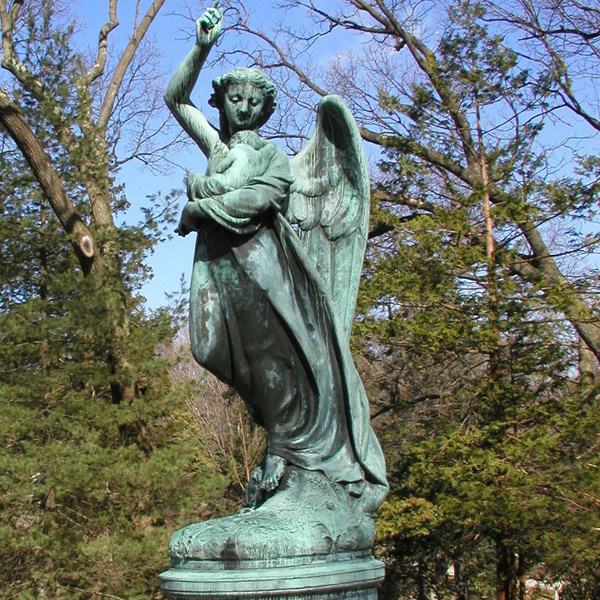
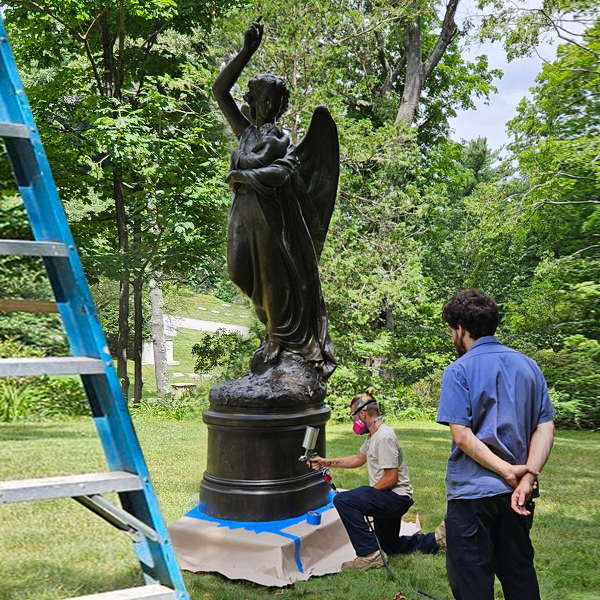
Nightingale Monument
Erected in the memory of realtor Samuel Nightingale’s (1828-1906) only child, Nina and his wife, also named Nina, this monument is a larger than life size bronze sculpture of an angel rising heavenward, bearing an infant in her arms. It is set on an oval-plan plinth cast by A. Rolland.
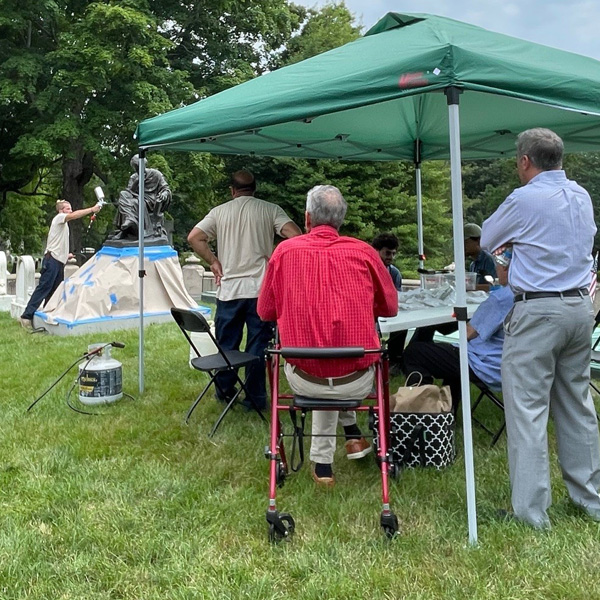
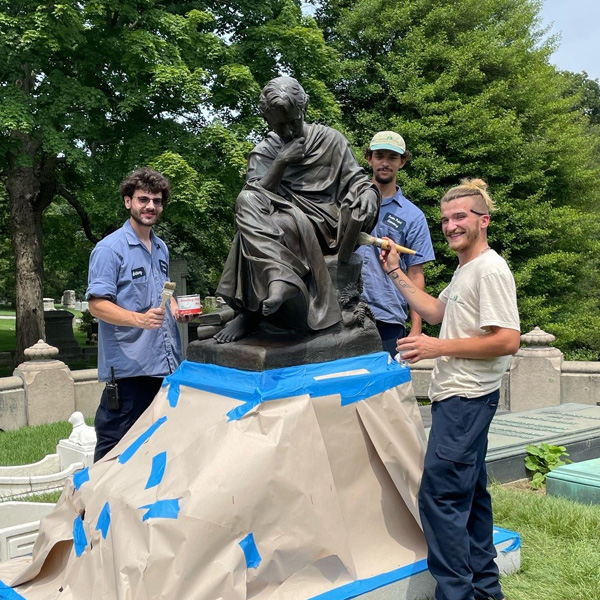
Sayles Monument
This bronze sculpture was created as a memorial for William Clark Sayles (1855-1876), who died while a student at Brown University. His parents employed German sculptor Henry Baerer (1837-1908), who exhibited at the National Academy of Design and whose works filled New York City’s parks, to design a pensive monument reminiscent of Michelangelo’s tomb of Lorenzo de’Medici in the New Sacristy of San Lorenzo in Florence.


Lownes Monument
The Lownes Monument features a bronze sculpture by Isidore Konti (1862-1938) a Viennese-born artist who studied at the Vienna Imperial Academy.